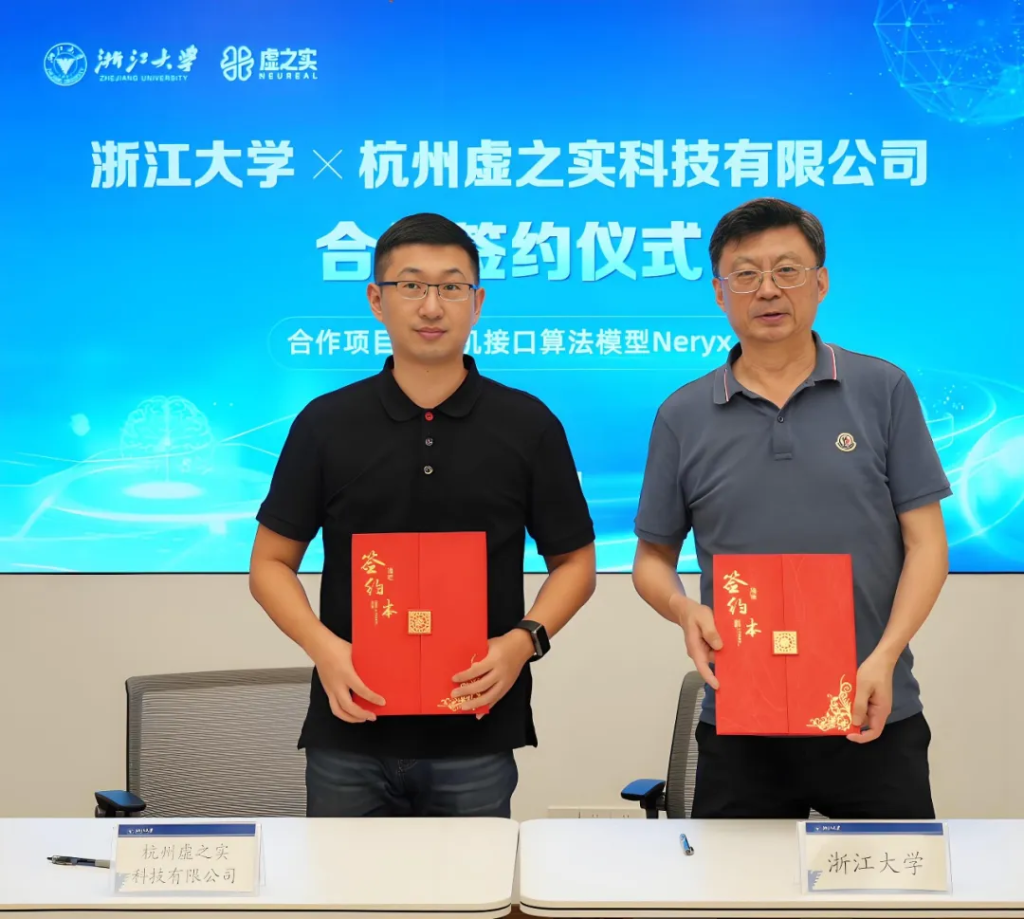
On October 19, Hangzhou NEUREAL Technology Co., Ltd. and the Institute of Basic Interdisciplinary Research at Zhejiang University officially signed a cooperation agreement for the “Brain-Computer Interface (BCI) Algorithm Model Neryx” project.Academician Bao Gang of the Chinese Academy of Sciences (CAS), Director of the Center for Mathematical Interdisciplinary Research at Zhejiang University,,and Kang Cheng, CEO of Hangzhou NEUREAL Technology Co., Ltd.,attended the signing ceremony.
This collaboration focuses onthe interdisciplinary integration of BCI, mathematical modeling, and Virtual Reality (VR) technology.The two parties will conduct scientific research cooperation in areas such as multimodal data mining, quantitative analysis of emotional states, emotion classification algorithm training, VR rehabilitation interaction modeling, and adaptive parameter optimization, promoting the combination of algorithm research with practical application scenarios and exploring effective paths for using BCI technology to serve public mental health.
BCI is a frontier technology integrating life sciences and information science. The “Implementation Opinions on Promoting Innovative Development of the BCI Industry” issued this year by seven departments including the Ministry of Industry and Information Technology clearly identifies it as a key direction for cultivating new quality productive forces and accelerating the formation of new tracks in future industries. Against this backdrop, this signing is an important measure by NEUREAL to respond to national strategies and deepen industry-academia-research collaboration, marking a critical step by the enterprise in the intersection of BCI and public mental health, and establishing a new platform for deep integration between university research capabilities and corporate industrial practices.
Targeting Key Technical Challenges, Exploring New Digital Paths for Public Emotional Rehabilitation
Public mental health concerns social livelihoods. Emotional states are influenced by various factors including physiology, cognition, and behavior. Accurately sensing emotional changes and dynamically adjusting interventions accordingly is a key challenge currently faced by both the BCI and digital intervention fields. This university-enterprise collaboration addresses precisely this issue.
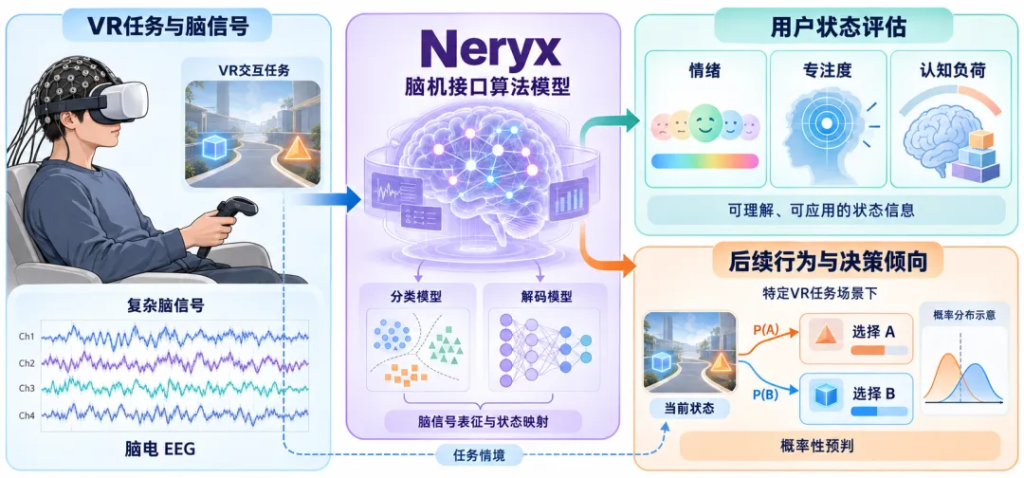
This project will use VR emotional induction and interactive scenarios as carriers to collect multimodal physiological signals such as EEG and photoplethysmography (PPG). Combined with behavioral data, it will study the correlation patterns between states such as anxiety, low mood, and emotional fluctuations and physiological characteristics.
In this research, the BCI algorithm model Neryx plays a core role. It transforms complex brain signals into understandable and applicable state information. Users’ internal states, such as emotions, focus, and cognitive load, are assessed by Neryx to serve as reference bases for training and interaction design, enabling VR tasks to adjust difficulty, pace, and feedback according to the user’s current state. The true value of the model lies in solving the common industry challenge that “internal states are difficult to continuously sense, and interactions are hard to personalize.”
Centered on Neryx, the two parties will continue to conduct algorithm research and scenario validation, exploring its application potential in cognitive training, virtual reality, and intelligent interaction. The project will be advanced in phases according to the overall research plan, providing support for subsequent technical optimization and application implementation.
Joining Forces with Internationally Leading Academician Team, Building a Solid Mathematical and Algorithmic Foundation for BCI
Academician Bao Gang isa renowned scholar in the field ofinverse problems in mathematical physics. He is an academician of the CAS, the Academia Europaea, and the World Academy of Sciences. He currently serves as Director of the Center for Mathematical Interdisciplinary Research and Dean of the Faculty of Science at Zhejiang University, and as Chairman of the China Society for Industrial and Applied Mathematics. He has long engaged in research in applied and computational mathematics, inverse problems in mathematical physics, etc. He was invited to speak at the International Congress of Mathematicians, received the Second Prize of the National Natural Science Award, and has been listed as a Highly Cited Researcher globally for many consecutive years. Mathematical modeling and inverse problem research can provide methodological support for complex signal analysis and multimodal data feature extraction. The participation of the academician team in this project will provide academic support for relevant algorithm research and model construction.
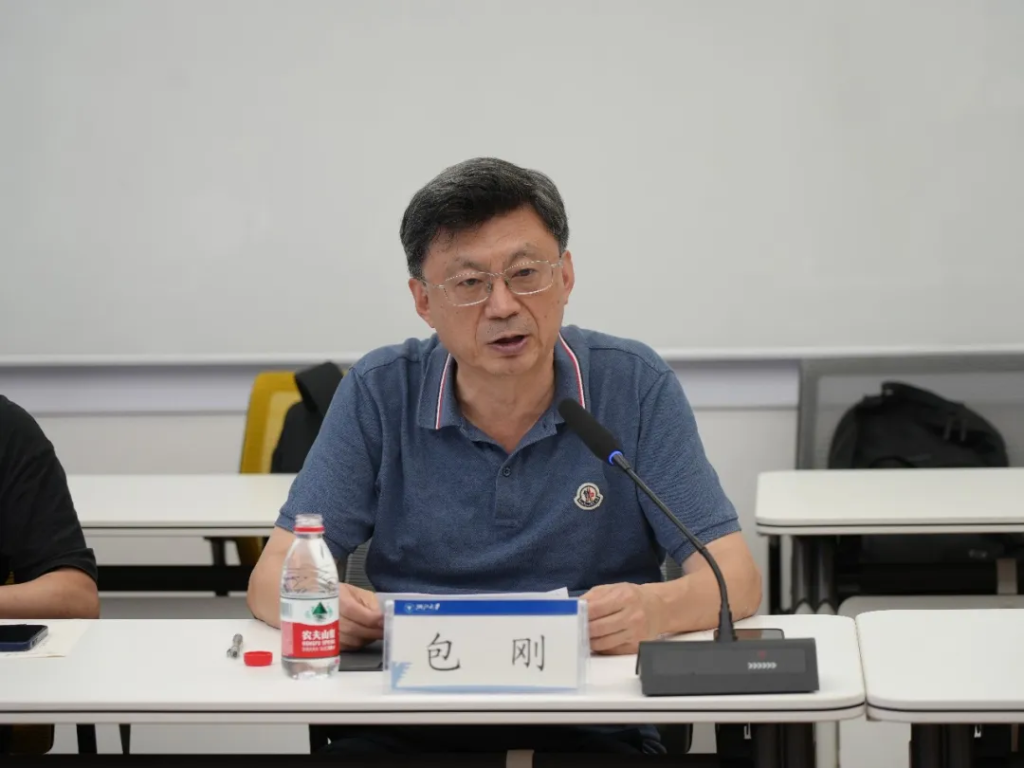
This collaboration will leverage Zhejiang University’s academic strengths in applied mathematics and algorithm research, combined with NEUREAL’s technical accumulation in BCI data acquisition, VR rehabilitation interaction, and scenario applications. They will carry out collaborative R&D around key links such as algorithms, models, and data, ensuring that mathematical modeling methods better address practical issues in product development.
By combining multimodal data analysis with interactive system modeling, the two parties hope to further clarify the relationships among emotional state characteristics, rehabilitation task parameters, and training feedback, providing more targeted technical basis for subsequent algorithm optimization and product iteration.
Deepening Industry-Academia-Research-Application Collaboration, Driving Scientific Achievements Toward Application Scenarios
Hangzhou NEUREAL Technology Co., Ltd. specializes in non-invasive BCI technology, conducting R&D centered on emotion and cognition decoding. It continuously explores the integrated application of AI, BCI, VR, and digital intervention technologies, advancing product development and application exploration for hospital clinical settings, public psychological intervention, and home-based brain health. The company’s related technologies have undergone over 10 years of R&D accumulation, with continuous promotion of productization and market application in the past five years. Currently, related products have entered nearly 1,000 institutions nationwide, and some products and services have also been implemented in overseas medical institutions. As application scenarios expand, the stability, generalization capability, and clinical validation of algorithm models have become important issues for the enterprise’s further development.
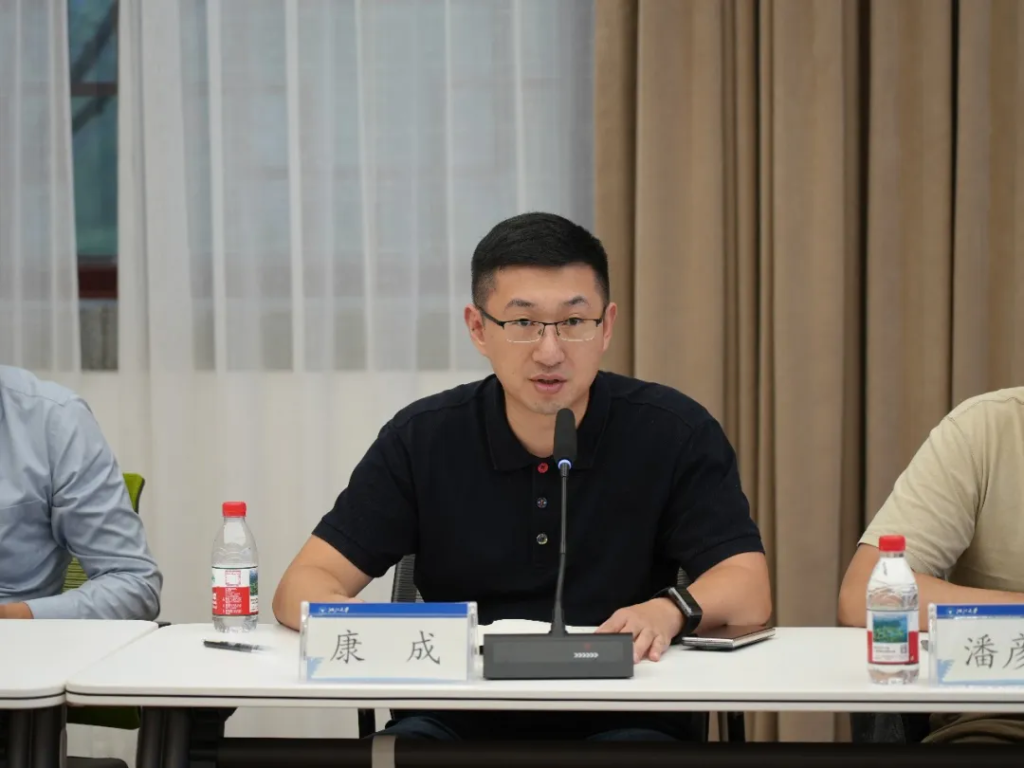
Moving BCI technology from the laboratory to real-world applications requires not only signal acquisition and engineering implementation capabilities but also coordinated advancement of algorithm models, data accumulation, effect validation, and scenario adaptation. This partnership with the Zhejiang University academician team reflects NEUREAL’s desire to leverage the university’s research advantages in mathematics and algorithms to strengthen model and data capabilities in product development and bridge the gap between research outcomes and real application needs.
Looking ahead, the two parties will take this signing as a starting point to continue advancing algorithm research, model training, and scenario validation, while exploring directions such as algorithm filing, compliant model application, and related medical device registration. Specific project progress remains subject to research results and regulatory requirements. NEUREAL will continue to deepen industry-academia-research-application cooperation with universities and research institutions, combining corporate application scenarios with university disciplinary strengths to better connect basic research, technology development, and industrial application, supporting the development of BCI technology and public mental health services.